Inside the Snitch & Enforcer: A Dual-Layer Defense
Decoupling detection from execution in genetic circuit design.

Sogand Azadeh
Co-Founder & Research Lead
Architecture of a Kill Switch
Biocontainment systems often fail because they are too "leaky" (killing cells when they shouldn't) or too slow (letting cheaters escape). To solve this, we decoupled the logic into two distinct modules: The Snitch (Sensor) and The Enforcer (Actuator). This separation allows us to tune the sensitivity of the sensor without altering the lethality of the kill switch.
Module 1: The Snitch (Sensing Stress)
Productive cells are stressed cells. The "Snitch" module utilizes a modified heat-shock promoter ($P_{htpG}$) tuned to respond specifically to the burden of heterologous protein aggregation.
When a cell is actively producing your difficult protein, the Snitch is active. It produces a steady stream of a specific repressor protein (Cl-434).
Simply put: Working hard = Safety Signal ON.
We engineered the promoter library to offer varying sensitivities. For extremely toxic proteins, we use a "Low Sensitivity" Snitch that requires massive stress to trigger. For easy-to-express proteins, a "High Sensitivity" version ensures even minor slackers are caught.
Module 2: The Enforcer (The Kill)
The "Enforcer" is a tightly regulated toxin-antitoxin system integrated into the genome or on a low-copy plasmid. The toxin gene is chemically repressed by the signal from the Snitch.
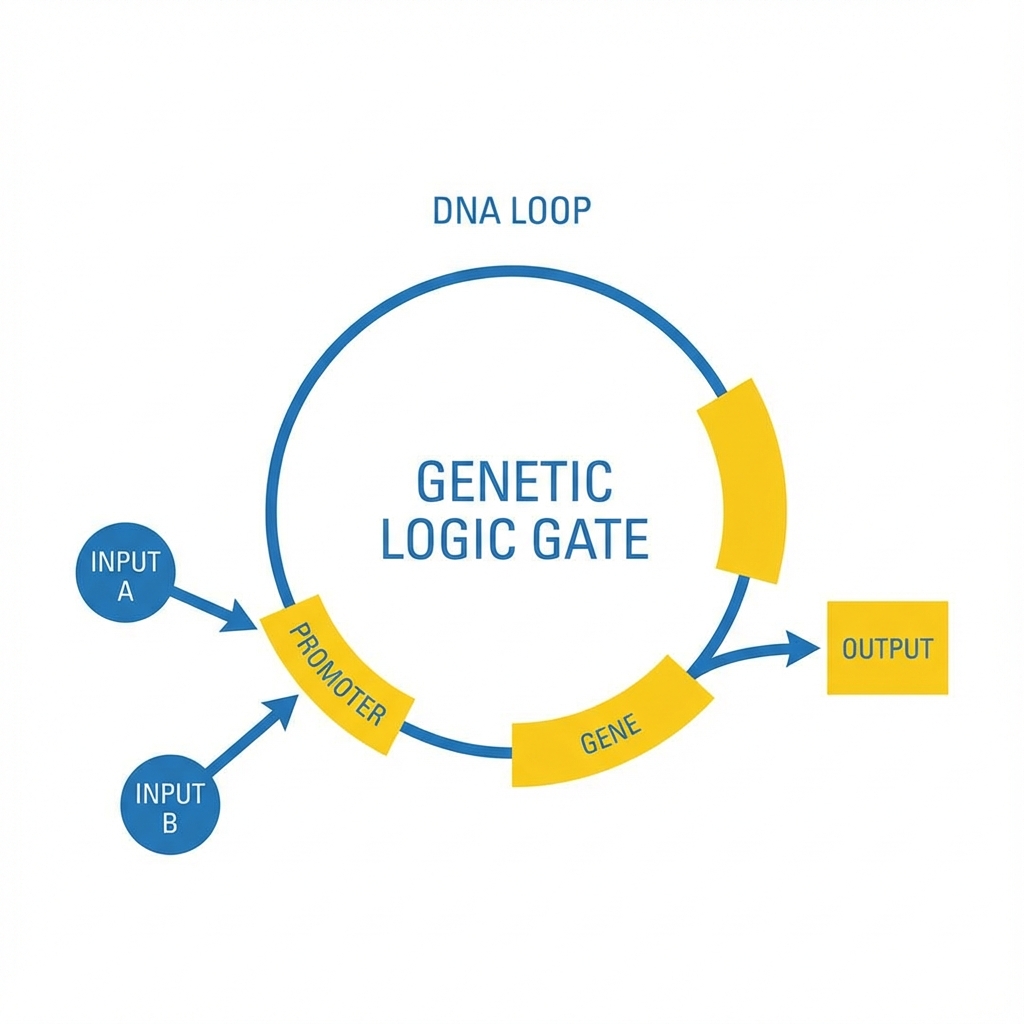
The Logic Gate (AND NOT)
The circuit functions as a biological Boolean gate:
Survival = (Has Plasmid) AND (Is Stressed)
- Scenario A (Productive Cell): Snitch is ON -> Repressor made -> Toxin Silenced -> Cell Lives.
- Scenario B (Cheater Cell): No protein production -> No Stress -> Snitch OFF -> No Repressor -> Toxin Expressed -> Cell Lysis.
Preventing Escape Mutants
A common failure mode in kill switches is mutation of the toxin gene itself. We mitigated this by using redundancy. The Enforcer module contains two distinct toxins targeting different cellular machinery (e.g., Gyrase inhibition and Membrane depolarization). The probability of a cell simultaneously mutating both toxin genes to escape is calculated at less than $10^{-14}$.
The Result: Pure Yield
This logic gate ensures that only cells properly expressing the target pathway survive. Any mutation that breaks the production pipeline—whether it's plasmid loss, gene deletion, or ribosome stalling—simultaneously cuts the safety line, causing the cell to self-terminate immediately.